

Individualized Targeted Immnotherapy
CIOFM has always taken a broader view of care.
That means staying rooted in what is known and validated, while also paying attention to emerging therapies that approach healing from outside the box of what is offered in conventional settings.
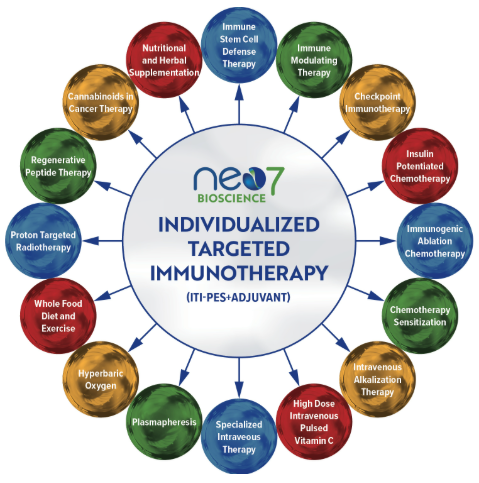
Neo7 Bioscience targeted immunotherapy was introduced to our clinic through that lens and as the first practice in the region to offer this innovative treatment option.
There are times in care when the question shifts from treatment alone to how well the body is holding up inside that treatment.
Peptides are one way we can begin to support those changes at a more targeted, cellular level.
They are used alongside ongoing care to help stabilize key systems that are under strain, whether that strain is coming from cancer, treatment, or longer-term health challenges.

What Peptides Are and How They Work
Peptides are short chains of amino acids that act as signaling molecules throughout the body.
They help regulate when to repair, activate the immune system, calm inflammation, and rebuild tissue.
Under normal conditions, these signals function efficiently. Under stress such as cancer, treatment, chronic inflammation, or infection, that communication can become disrupted.
Targeted peptides are designed to help restore those signals. Rather than forcing a single pathway, they support the body’s existing processes and bring them back into better regulation.
Neo7 formulations are selected for specific biologic effects, focusing on the patient’s top 10-14 misfiring signals for personalized treatment.
Targeted Immnotherapy Uses
Cancer & Active Disease
Neo7 was initially developed for use in cancer and complex disease states, where multiple signaling pathways are disrupted at once.
Using genomic, biomarker, and molecular data, this approach helps identify how a patient’s disease is expressing itself at an individual level, rather than treating all cases the same.
Peptides are then designed to target those specific disruptions, including areas such as immune recognition, inflammatory signaling, and cellular repair.
In this setting, Neo7 is used alongside conventional and integrative oncology care, with the goal of supporting how the body responds to treatment and manages disease burden.
Post-Viral and Spike-Related Complications
A second area of focus involves patients dealing with persistent symptoms following viral illness or mRNA vaccination.
Neo7 refers to this as a need for deeper “molecular surveillance,” identifying disruptions in immune signaling, inflammation, and gene expression that may not be visible through standard testing.
This can include patterns such as:
Ongoing immune dysregulation
Inflammatory and autoimmune responses
Changes in cellular signaling or protein expression
Peptide design in this context is intended to address those individualized disruptions and support a more stable physiologic response.
This remains an evolving area of medicine, and all care is approached with careful clinical judgment and appropriate oversight.
Resilience, Recovery, and Longevity
Neo7 also applies its precision model to patients who are not in active disease, but are focused on maintaining or restoring function.
In this setting, the goal shifts toward optimizing key pathways involved in:
Immune balance
Mitochondrial function and energy production
Inflammation control
DNA repair and cellular stability
Metabolic and hormonal regulation
Rather than reacting to illness, this approach is used to support long-term resilience and help the body adapt more effectively over time.

The Neo7 Targeted Immnotherapy Process
-
The process starts with advanced testing designed to capture how your body is signaling and responding across multiple systems.
This may include analysis of:
Whole exome sequencing (WES) from blood and tumor
RNA expression patterns
Circulating tumor DNA (cfDNA/ctDNA)
Proteomics from urine
Broader biomarker evaluation
Together, this creates a more complete picture of what is happening beneath the surface, not just at the level of diagnosis, but at the level of active biological communication.
-
Once the data is collected, it is analyzed to identify where signaling is disrupted.
This includes areas such as:
Immune recognition and response
Inflammatory pathways
Metabolic regulation
Cellular stress and repair mechanisms
Rather than focusing on a single target, the Neo7 model looks for patterns. The goal is to identify the key areas where communication has broken down and prioritize them.
-
Using this data, a personalized peptide formulation is created.
This process includes:
Generating peptide candidates based on your molecular profile
Refining and organizing peptide sequences
Ranking peptides based on predicted effectiveness
Evaluating safety and producibility
Additional analysis, such as HLA susceptibility, is used to determine how your immune system is likely to recognize and respond to these peptides.
The end result is a formulation designed specifically for your biology, not a general protocol.
-
This is not an immediate-start therapy.
From initial testing to finalized peptide design, the process typically takes about 11 weeks:
~6 weeks for testing and data collection
~3–4 weeks for analysis and peptide design
Once complete, the peptides are compounded and prepared for use.
-
Peptides are administered on a structured schedule, typically:
Two doses per week
Over a 9–12 month period
Dosing and administration are guided by your provider and integrated with your broader care plan.
Certain therapies may need to be timed carefully around peptide use, and your care team will walk you through those details.
-
At approximately 10 months, repeat testing is performed to evaluate how your biology has shifted.
From there, decisions are made about:
Continuing the current plan
Adjusting the peptide formulation
Moving into another phase of care
Some patients complete a single cycle. Others may go through additional rounds depending on their clinical situation.
If you are currently a CIOFM patient, your care team can help you determine whether Neo7 Targeted Immunotherapy is appropriate within your existing plan.
If you are new to the practice, the first step is a Discovery Call. This gives us the opportunity to review your history, understand your goals, and determine whether this approach is a fit for you.
This treatment does require an ongoing relationship with our care team and enrollment in the CIOFM program